By Surya Padhi, EA, CAA
Sure Financial & Tax Services
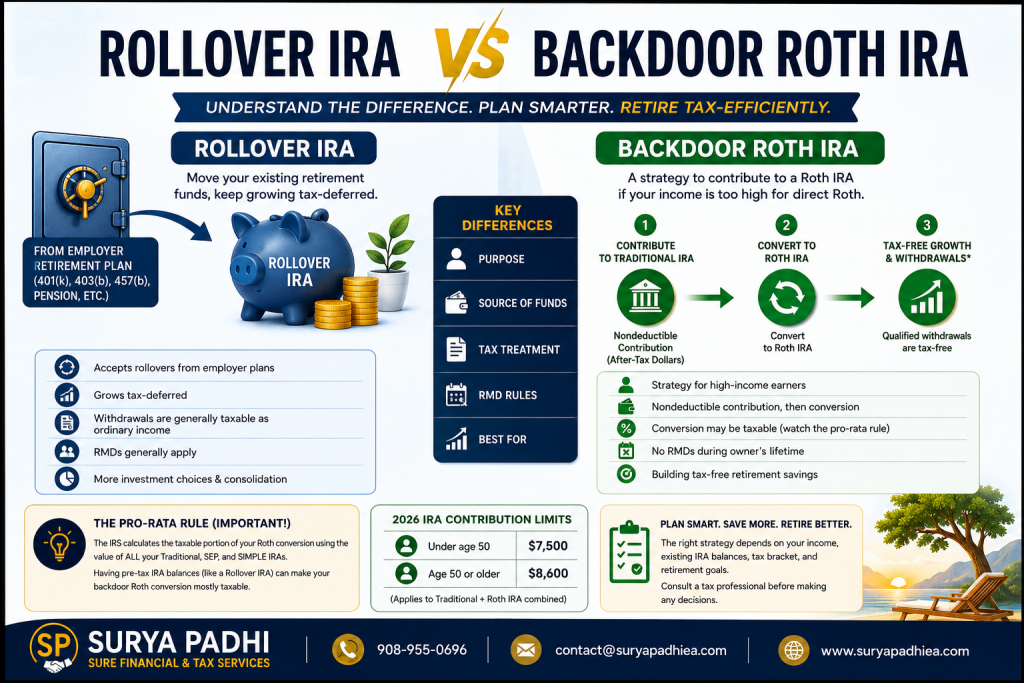
Retirement terminology can be confusing, especially when people compare a Rollover IRA with a Backdoor Roth IRA.
Although both involve individual retirement accounts, they serve very different purposes:
- A Rollover IRA generally receives retirement funds transferred from an employer-sponsored plan, such as a 401(k).
- A Backdoor Roth IRA is a tax strategy that generally involves making a nondeductible contribution to a Traditional IRA and then converting that amount to a Roth IRA.
The correct choice depends on your income, existing retirement accounts, current tax bracket, future tax expectations, and long-term financial goals.
What Is a Rollover IRA?
A Rollover IRA is generally a Traditional IRA used to receive money from an employer-sponsored retirement plan.
Common sources include:
- Traditional 401(k)
- 403(b)
- Governmental 457(b)
- Employer profit-sharing plan
- Certain pension or retirement-plan distributions
A properly completed direct rollover generally moves retirement funds from the former employer’s plan directly to the IRA custodian without current taxation.
How a Rollover IRA Is Taxed
If the original retirement funds were pre-tax:
- The rollover itself is generally not taxable when properly completed.
- The funds continue to grow tax-deferred.
- Future withdrawals are generally taxed as ordinary income.
- Required Minimum Distribution rules may apply later.
The IRS generally limits indirect IRA-to-IRA rollovers to one during a 12-month period, although direct trustee-to-trustee transfers are generally treated differently.
Why People Use Rollover IRAs
A Rollover IRA may provide:
- Continued tax deferral
- Broader investment options
- Consolidation of old retirement accounts
- Easier account management
- Greater beneficiary and estate-planning flexibility
However, rolling funds out of a former employer plan can also mean losing certain plan-specific protections or withdrawal options.
What Is a Backdoor Roth IRA?
A Backdoor Roth IRA is not a separate type of IRA recognized by the tax code. It is a commonly used strategy for taxpayers whose income is too high to make a direct Roth IRA contribution.
The strategy generally involves:
- Making a nondeductible contribution to a Traditional IRA.
- Converting the Traditional IRA balance to a Roth IRA.
- Reporting the transaction on IRS Form 8606.
The IRS confirms that Roth conversions may generally be available regardless of adjusted gross income.
Why High-Income Taxpayers Use the Backdoor Roth Strategy
Direct Roth IRA contributions are subject to income limits.
For 2026, the Roth IRA contribution phase-out ranges are:
- Single or Head of Household: $153,000 to $168,000
- Married Filing Jointly: $242,000 to $252,000
- Married Filing Separately while living with spouse: $0 to $10,000
Taxpayers above the applicable range generally cannot make a direct Roth IRA contribution, but they may still be able to use a Roth conversion strategy.
2026 IRA Contribution Limits
For 2026, the combined contribution limit for all Traditional and Roth IRAs is:
- $7,500 for individuals under age 50
- $8,600 for individuals age 50 or older
The limit also cannot exceed the taxpayer’s taxable compensation for the year.
A rollover from a qualified retirement plan generally does not count against the annual IRA contribution limit.
Rollover IRA vs. Backdoor Roth IRA: Key Differences
| Feature | Rollover IRA | Backdoor Roth IRA |
|---|---|---|
| Primary purpose | Move employer retirement funds into an IRA | Fund a Roth IRA when direct contributions are restricted |
| Typical source of funds | 401(k), 403(b), 457(b), or pension plan | Personal after-tax contribution |
| Annual contribution limit | Rollovers generally are not limited by the annual IRA contribution cap | Subject to the annual IRA contribution limit |
| Current tax deduction | Not applicable to the rollover itself | Traditional IRA contribution is usually nondeductible |
| Conversion involved | Not necessarily | Yes |
| Current taxable income | Usually none with a proper pre-tax rollover | May be taxable depending on pre-tax IRA balances and earnings |
| Future withdrawals | Generally taxable | Qualified Roth IRA withdrawals are generally tax-free |
| Required Minimum Distributions | Generally apply to Traditional IRAs | Roth IRAs generally have no lifetime RMDs for the original owner |
| Form 8606 | Usually not needed solely for a pre-tax rollover | Generally required |
The Most Important Issue: The Pro-Rata Rule
The biggest tax trap in a Backdoor Roth IRA strategy is the pro-rata rule.
The IRS does not allow taxpayers to isolate only the after-tax dollars in one Traditional IRA when calculating the taxable portion of a Roth conversion.
Instead, the calculation generally considers the year-end balances in all of the taxpayer’s:
- Traditional IRAs
- SEP IRAs
- SIMPLE IRAs
The taxable and nontaxable portions are generally allocated proportionally. IRS guidance describes this as dividing the taxable amount in all IRAs by the total value of all IRAs.
Why a Rollover IRA Can Create a Backdoor Roth Problem
Suppose you roll $200,000 of pre-tax 401(k) money into a Rollover IRA.
Later, you contribute $7,500 of nondeductible money to another Traditional IRA and convert $7,500 to a Roth IRA.
You may expect the conversion to be tax-free because you contributed after-tax money. However, the IRS generally aggregates the Rollover IRA with your other Traditional, SEP, and SIMPLE IRAs.
Because most of your total IRA balance consists of pre-tax money, most of the $7,500 conversion may be taxable.
Backdoor Roth Example Without an Existing IRA Balance
Situation
David is single and earns too much to contribute directly to a Roth IRA in 2026.
He has:
- No Traditional IRA balance
- No SEP IRA balance
- No SIMPLE IRA balance
- No Rollover IRA balance
He contributes $7,500 to a Traditional IRA as a nondeductible contribution and converts the full amount to a Roth IRA shortly afterward.
Potential Tax Result
If the account has no investment gain before conversion:
- Nondeductible contribution: $7,500
- Roth conversion: $7,500
- Potential taxable conversion amount: approximately $0
David must still properly report the contribution and conversion, generally using Form 8606.
Form 8606 is used to report nondeductible Traditional IRA contributions and conversions from Traditional, SEP, or SIMPLE IRAs to Roth IRAs.
Backdoor Roth Example With a Rollover IRA
Situation
Maria has:
- $192,500 in a pre-tax Rollover IRA
- A new $7,500 nondeductible Traditional IRA contribution
- Total Traditional IRA assets of $200,000
She converts $7,500 to a Roth IRA.
Simplified Pro-Rata Calculation
After-tax basis: $7,500
Total IRA balance: $200,000
Nontaxable percentage: $7,500 ÷ $200,000 = 3.75%
Approximate nontaxable portion of the $7,500 conversion: $7,500 × 3.75% = $281
Approximate taxable portion: $7,500 − $281 = $7,219
Although Maria contributed after-tax money, most of the conversion may be taxable because of her existing pre-tax Rollover IRA.
This is a simplified illustration. The actual Form 8606 calculation may also consider distributions, conversions, and year-end account values.
Can You Move a Rollover IRA Back Into a 401(k)?
Some employer plans accept incoming rollovers from Traditional or Rollover IRAs.
When permitted, a taxpayer may be able to move eligible pre-tax IRA funds into an employer plan, potentially reducing or eliminating the pre-tax IRA balance considered under the Roth conversion pro-rata calculation.
However:
- The employer plan must accept incoming rollovers.
- After-tax basis should not be rolled into a pre-tax employer account without careful review.
- Plan fees and investment options should be evaluated.
- The transaction should be completed before year-end if it is part of a Backdoor Roth planning strategy.
This should be coordinated carefully with the plan administrator and a qualified tax professional.
Roth Conversion Tax Rules
When pre-tax retirement money is converted to a Roth IRA:
- The taxable amount is generally included in ordinary income.
- The conversion may increase your tax bracket.
- It may affect Medicare IRMAA premiums.
- It may increase the taxable portion of Social Security benefits.
- It may affect income-based tax credits and deductions.
A Roth conversion completed after 2017 generally cannot be recharacterized or reversed.
Rollover IRA Advantages
A Rollover IRA may be appropriate when you want to:
- Consolidate former employer retirement accounts
- Maintain tax-deferred growth
- Access a broader range of investments
- Simplify beneficiary planning
- Avoid maintaining multiple old 401(k) accounts
Rollover IRA Disadvantages
Potential disadvantages include:
- Future withdrawals are generally taxable.
- Required Minimum Distributions may apply.
- The balance can complicate Backdoor Roth IRA planning.
- You may lose certain employer-plan creditor protections.
- You may lose access to the Rule of 55.
- Investment costs may be higher than in a low-cost employer plan.
Backdoor Roth IRA Advantages
A properly executed Backdoor Roth IRA may offer:
- Tax-free qualified withdrawals
- Tax-free long-term growth
- No lifetime Required Minimum Distributions for the original owner
- Greater tax diversification
- Additional flexibility in retirement
- Potential estate-planning benefits
The IRS states that Roth IRA contributions are not deductible, qualified distributions may be tax-free, and amounts may generally remain in the account throughout the owner’s lifetime.
Backdoor Roth IRA Disadvantages
Potential concerns include:
- Pro-rata taxation
- Form 8606 reporting requirements
- Possible taxable investment gains before conversion
- Administrative complexity
- Risk of incorrect tax reporting
- Conversion taxes cannot generally be undone
- State tax treatment may differ from federal treatment
Can You Have Both?
Yes. A taxpayer can have both:
- A Rollover IRA containing former employer retirement funds
- A Roth IRA funded through direct contributions, conversions, or a Backdoor Roth strategy
However, the Rollover IRA balance can materially affect the tax treatment of a Backdoor Roth conversion.
The decision should therefore be made as part of an integrated retirement and tax plan.
Which Strategy Is Better?
A Rollover IRA may be more appropriate when:
- You recently left an employer.
- You want to consolidate retirement accounts.
- You want broader investment choices.
- You do not plan to use the Backdoor Roth strategy.
- Keeping the assets in the former employer plan is not beneficial.
A Backdoor Roth IRA may be more appropriate when:
- Your income exceeds the direct Roth contribution limit.
- You have taxable compensation.
- You have little or no pre-tax IRA balance.
- You want additional tax-free retirement assets.
- You can properly manage Form 8606 and the pro-rata rule.
Keeping Money in a 401(k) may be more appropriate when:
- You plan to use the Backdoor Roth strategy.
- Your employer plan has low costs.
- You value stronger creditor protections.
- You may qualify for the Rule of 55.
- The plan accepts incoming IRA rollovers.
Common Mistakes to Avoid
Treating a Backdoor Roth as a Deductible Contribution
The Traditional IRA contribution used for the strategy is generally nondeductible.
Forgetting Form 8606
Failure to report nondeductible basis correctly can result in double taxation later.
Ignoring SEP and SIMPLE IRA Balances
These accounts are generally included in the pro-rata calculation.
Looking Only at the Conversion-Date Balance
The pro-rata calculation generally considers applicable IRA values at year-end.
Rolling a 401(k) Into an IRA Before Reviewing the Backdoor Roth Impact
A rollover may unintentionally create a large pre-tax IRA balance and make future Roth conversions mostly taxable.
Assuming a Roth Conversion Can Be Reversed
Conversions made after 2017 generally cannot be recharacterized.
Final Takeaway
A Rollover IRA and a Backdoor Roth IRA serve different purposes.
A Rollover IRA helps preserve and consolidate retirement funds from an employer plan. A Backdoor Roth IRA helps certain high-income taxpayers place new retirement savings into a Roth IRA through a nondeductible contribution and conversion.
The key planning issue is that a Rollover IRA can interfere with the tax efficiency of a Backdoor Roth IRA because of the IRS pro-rata rule.
Before moving a 401(k), making a nondeductible contribution, or completing a Roth conversion, evaluate the entire retirement-account structure—not just one account.
Schedule a Retirement Tax Planning Consultation
Whether you are changing jobs, considering a 401(k) rollover, evaluating a Backdoor Roth IRA, or planning a larger Roth conversion, we can help you develop a personalized strategy designed to minimize taxes and strengthen your retirement plan.
Our services include:
- Rollover IRA tax analysis
- Backdoor Roth IRA planning
- Form 8606 review
- Roth conversion projections
- Pro-rata rule analysis
- 401(k) rollover guidance
- Required Minimum Distribution planning
- Medicare IRMAA planning
- Retirement income tax projections
Surya Padhi, EA, CAA
Enrolled Agent | Certified Acceptance Agent
Sure Financial & Tax Services
📞 908-955-0696
📧 contact@suryapadhiea.com
🌐 www.suryapadhiea.com
Plan Today. Minimize Taxes. Build Tax-Free Retirement Income.
Disclaimer: This article is provided for general educational purposes and does not constitute individualized tax, legal, financial, or investment advice. IRA conversions, rollovers, Form 8606 reporting, and pro-rata calculations depend on the taxpayer’s complete financial circumstances. Consult a qualified tax and financial professional before completing a transaction.