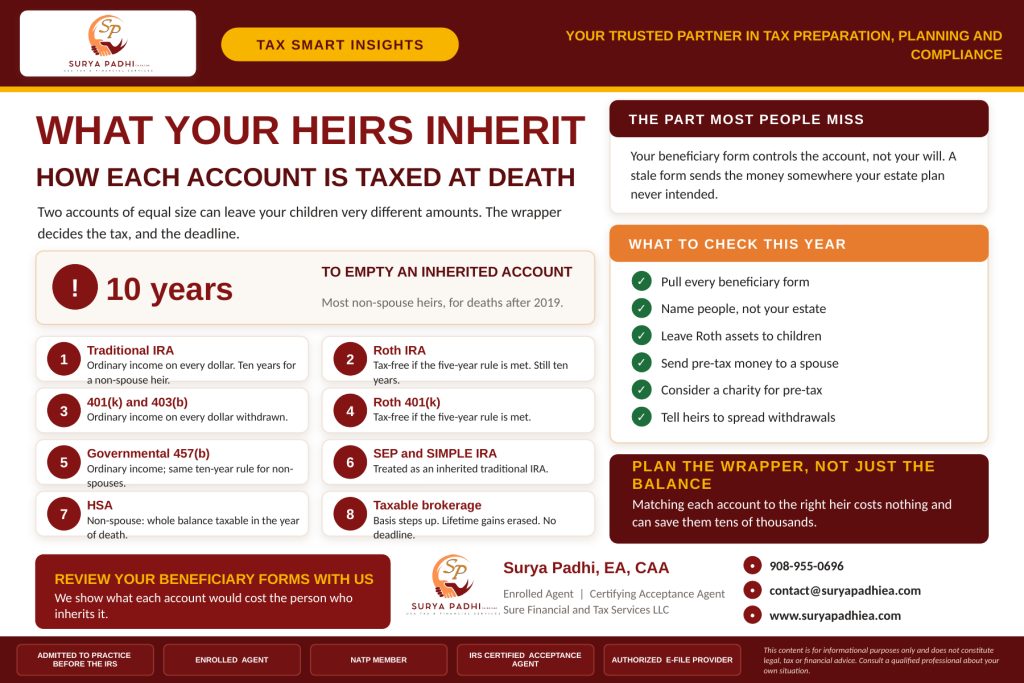
Most people spend years thinking about how much they will leave behind and almost no time on which account it sits in. That is backwards. A $500,000 traditional IRA and a $500,000 brokerage account are not the same inheritance. One arrives with a tax bill attached and a ten-year deadline. The other arrives with a lifetime of gains erased.
Here is how each account is treated when the owner dies, who has to empty it and when, and the handful of decisions that change the outcome for your family. None of them require moving money or changing how it is invested.
| KEY TAKEAWAYS Most non-spouse heirs must empty an inherited retirement account within ten years of the owner’s death.Pre-tax accounts are taxed as ordinary income to the heir; Roth accounts generally are not.A taxable brokerage account gets a step-up in basis at death. No retirement account does.Your beneficiary designation controls the account, regardless of what your will says. |
| IN THIS ARTICLE 1. What changed in 2020, and why it matters now 2. Account by account: what your heirs actually receive 3. Who gets to stretch, and who does not 4. What the ten-year rule actually costs 5. Spouse or child: the same account, different rules 6. Four things worth doing this year |
What changed in 2020, and why it matters now
Before the SECURE Act, an heir who inherited an IRA could stretch withdrawals across their own life expectancy. A 40-year-old inheriting from a parent might spread the account over four decades, taking small amounts each year and letting the rest compound. That was the stretch IRA, and for most beneficiaries it no longer exists.
For owners who died after 2019, the rule for most non-spouse heirs is ten years. The account must be empty by December 31 of the tenth year following the year of death. There is no requirement to take anything in a particular year unless the owner had already begun required minimum distributions — in which case annual withdrawals apply during the ten-year window as well.
| ⚠ The part that catches people The ten-year rule is not the same as ten equal payments. Nothing stops an heir from waiting until year ten, and that is exactly the choice that costs the most money. |
Account by account: what your heirs actually receive
The differences below are not marginal. They are the difference between an heir keeping most of an account and keeping about two-thirds of it.
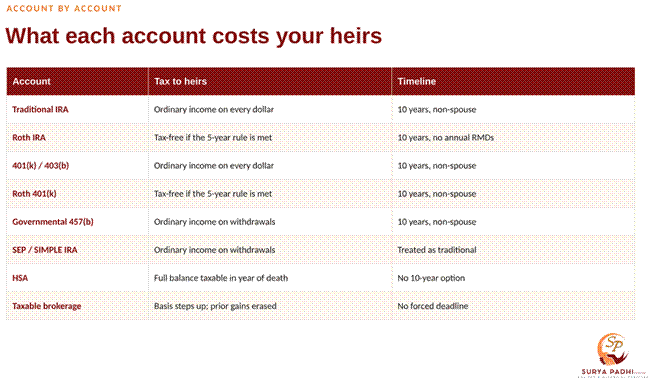
Figure 1 — Pre-tax accounts arrive with a tax bill; Roth and brokerage accounts largely do not.
Pre-tax accounts: traditional IRA, 401(k), 403(b), 457(b), SEP and SIMPLE
Every dollar withdrawn is ordinary income to the heir, added on top of whatever they already earn. There is no capital gains treatment and no step-up in basis, no matter how long the account was held or how much of the balance is growth. A SEP or SIMPLE IRA is treated as an inherited traditional IRA.
Roth IRA and Roth 401(k)
Qualified distributions are generally tax-free to the heir, provided the five-year rule has been satisfied. The ten-year deadline still applies — the heir must empty the account — but they choose when, and the growth during those ten years comes out untaxed. This is what makes Roth assets the most valuable thing to leave a child who already earns well.
Health savings accounts
The HSA is the harshest account to inherit and the one almost nobody checks. A surviving spouse inherits it as their own HSA and nothing changes. Anyone else — a child, a sibling, a friend — does not get an HSA at all. The account ceases to be an HSA on the date of death and the full fair market value becomes taxable income to the beneficiary in that year. There is no ten-year spread available.
| ✓ One narrow relief on an inherited HSA The taxable amount can be reduced by the decedent’s qualified medical expenses, if the beneficiary pays them within one year of the date of death. It is a real reduction and it is easy to miss, because it requires action in the months when a family is least able to think about tax. |
Taxable brokerage accounts
This is the most favourable account to inherit. The basis steps up to fair market value at the date of death, which means a lifetime of unrealised gains is erased for income tax purposes. Heirs can sell immediately with little or no gain, and there is no forced timeline at all.
Who gets to stretch, and who does not
The ten-year rule applies to most beneficiaries, but not all. A category called eligible designated beneficiaries may still use life expectancy:
- A surviving spouse, who additionally may roll the account into their own IRA
- A minor child of the account owner, until they reach age 21 — after which the ten-year clock starts
- A beneficiary who is disabled or chronically ill
- A beneficiary not more than ten years younger than the owner
Everyone else — adult children, grandchildren, siblings, friends, and most trusts — falls under the ten-year rule. In practice that means the typical case, a parent leaving an IRA to an adult child, gets ten years and no more.
What the ten-year rule actually costs
The deadline itself is not the expensive part. The expensive part is what heirs do with it.
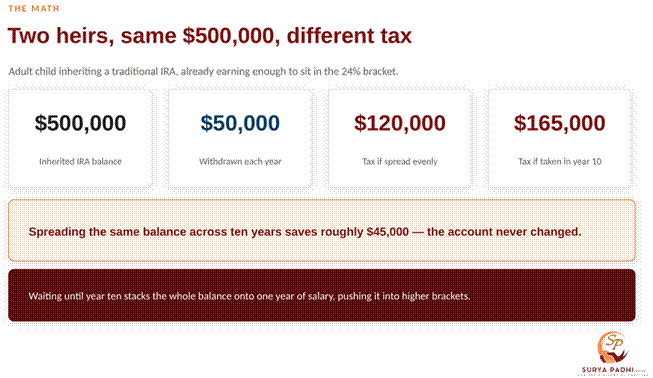
Figure 2 — Same account, same heir, roughly $45,000 of difference in timing alone.
| Adult child inherits a $500,000 traditional IRA Balance inherited $500,000 Withdrawn evenly over ten years $50,000 / yr Approximate tax at a 24% marginal rate $120,000 Approximate tax if taken entirely in year 10 $165,000 Cost of the timing decision alone about $45,000 Illustrative. Actual results depend on the heir’s own income, filing status, state, and the brackets in force each year — verify before relying on any figure here. |
An heir who takes roughly a tenth each year keeps the withdrawals near their existing bracket. An heir who waits stacks the entire balance onto a single year of salary and pushes a large slice of it into higher brackets. The account did not change. Only the timing did.
| ℹ If annual withdrawals are required Where the owner died on or after their required beginning date, the heir must also take annual distributions during the ten years. Missing one carries a penalty — reduced substantially if corrected promptly — so this is worth confirming with the custodian in the first year rather than the tenth. |
Spouse or child: the same account, different rules
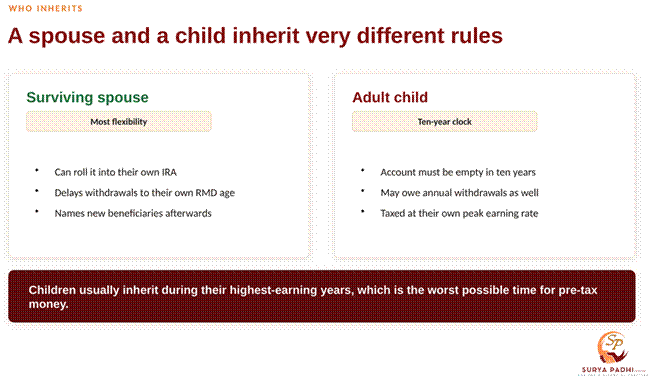
Figure 3 — A spouse can reset the clock. A child cannot.
A surviving spouse has options nobody else does. They can roll the account into their own IRA, treat it as their own, delay withdrawals until their own required beginning age, and name a fresh set of beneficiaries. In effect the clock restarts.
An adult child gets ten years, possibly with annual withdrawals along the way, taxed at whatever rate their own career has put them in. And children typically inherit in their forties and fifties — their highest-earning years, and the worst possible time to receive pre-tax money.
The goal is not a smaller estate. It is putting each dollar where it will be taxed least on the way out.
Four things worth doing this year
- Pull every beneficiary form and read it. Check with each custodian directly rather than relying on memory or on what your will says — the form controls the account.
- Name people, not your estate. Naming the estate as beneficiary can forfeit the ten-year treatment and shorten the payout window considerably.
- Match the account to the heir. Leave Roth and brokerage assets to children in high brackets; leave pre-tax money to a spouse, or to charity.
- Give your heirs the withdrawal plan in writing. Tell them to spread the money across the ten years, and tell them why.
| ⚠ The honest trade-off Converting pre-tax money to Roth during your lifetime does spare your heirs the tax — but you pay it instead, now, at your rate rather than theirs. That only makes sense when your bracket is genuinely lower than theirs will be, which is a calculation, not an assumption. |
If you give to charity at all, this is the single cleanest move available: a qualified charity receives an inherited IRA free of income tax, while your children never will. Directing pre-tax dollars to charity and after-tax dollars to family often costs the family nothing and saves the tax entirely.
Frequently asked questions
Does my will control who inherits my IRA?
No. Retirement accounts pass by beneficiary designation, and that form overrides your will. If the form names an ex-spouse or a person who has died, that is what the custodian follows. This is why reviewing beneficiary forms is the highest-value hour in estate planning.
Do my heirs have to take money out every year?
It depends on whether you had already begun required minimum distributions. If you died on or after your required beginning date, most non-spouse heirs must take annual distributions during the ten-year period as well as emptying the account by the end of it. If you died before that date, they generally have flexibility on timing within the ten years.
Is an inherited Roth IRA really tax-free?
Qualified distributions generally are, provided the five-year rule has been met. The heir still must empty the account within ten years, but the withdrawals themselves, including growth during those ten years, are generally not taxed.
What happens if I leave my HSA to my children?
The account stops being an HSA on the date of death and the full balance becomes taxable income to them in that year. There is no ten-year spread. A surviving spouse is the exception and inherits it as their own HSA. If your HSA balance is significant, this is worth revisiting deliberately.
Why does a brokerage account get better treatment than a retirement account?
Because of the step-up in basis at death. Appreciated securities in a taxable account pass to heirs at their market value on the date of death, erasing the prior gains for income tax purposes. Retirement accounts receive no step-up at all — every pre-tax dollar remains taxable to whoever withdraws it.
| Do you know what your beneficiary forms actually say? We review every account against your heirs’ brackets and show what each one would cost the person who inherits it — including the accounts most plans overlook. 908-955-0696 • contact@suryapadhiea.com • suryapadhiea.com |
This article is general educational information, not individualized tax or investment advice. Figures cited are subject to IRS adjustment. Consult a qualified professional about your own facts.