A Complete Guide to Citizenship, Property Ownership, FEMA Rules, and Tax Planning
By Surya Padhi, EA, CAA
Sure Financial & Tax Services
NRI vs. OCI – Why Understanding the Difference Matters
If you’re living outside India or planning to invest in Indian real estate, stocks, mutual funds, or businesses, you’ve probably come across the terms NRI (Non-Resident Indian) and OCI (Overseas Citizen of India).
/
Although these terms are often used interchangeably, they are not the same. Your status affects your:
- Property purchase rights
- Banking options
- Tax obligations
- FEMA compliance
- Investment opportunities
- Estate planning
- Repatriation of funds
Choosing the correct financial strategy begins with understanding your legal status.
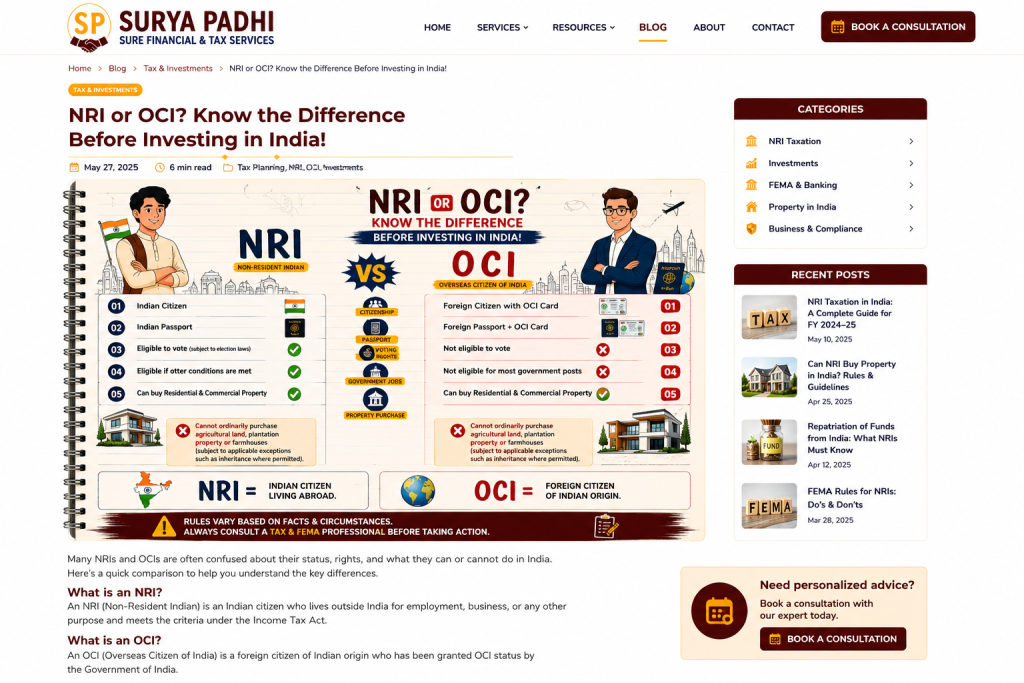
What is an NRI?
An NRI (Non-Resident Indian) is an Indian citizen who resides outside India for employment, business, education, or other qualifying purposes.
An NRI:
- Holds an Indian passport
- Remains an Indian citizen
- May own property in India
- Can invest under FEMA regulations
- May maintain NRE, NRO and FCNR accounts
- May vote in India subject to election rules
What is an OCI?
An OCI (Overseas Citizen of India) is a foreign citizen of Indian origin who has been granted OCI status by the Government of India.
An OCI cardholder:
- Holds a foreign passport
- Is not an Indian citizen
- Enjoys lifelong visa benefits (subject to current regulations)
- Can generally invest and own residential/commercial property
- Cannot vote in Indian elections
- Cannot hold constitutional offices reserved for Indian citizens
Despite the name, OCI is not dual citizenship.
NRI vs OCI: Quick Comparison
| Feature | NRI | OCI |
|---|---|---|
| Citizenship | Indian Citizen | Foreign Citizen |
| Passport | Indian Passport | Foreign Passport + OCI Card |
| Voting Rights | Eligible under election rules | Not Eligible |
| Government Jobs | Eligible for certain positions | Restricted |
| Residential Property | Allowed | Allowed |
| Commercial Property | Allowed | Allowed |
| Agricultural Land | Generally Restricted | Generally Restricted |
| Bank Accounts | NRE/NRO/FCNR | NRO & eligible banking facilities |
Property Purchase Rules
One of the biggest misconceptions concerns real estate ownership.
Both NRIs and OCI cardholders can generally purchase:
- Apartments
- Residential homes
- Commercial buildings
- Office spaces
- Shops
However, both generally cannot directly purchase
- Agricultural land
- Plantation property
- Farmhouses
Certain exceptions may apply through inheritance or other provisions under applicable laws.
Before purchasing property, always review:
- FEMA regulations
- RBI guidelines
- Source of funds
- TDS requirements
- Capital gains implications
- Repatriation rules
Tax Residency Is Different from Citizenship
Many people assume that being an NRI automatically means they are a non-resident for tax purposes.
That’s incorrect.
Indian income-tax residency depends primarily on statutory residency tests—not simply your passport or OCI status.
Similarly, U.S. taxpayers may still have worldwide income reporting obligations regardless of their NRI or OCI status.
Investment Opportunities
Both NRIs and OCI cardholders can generally invest in:
- Indian equities
- Mutual funds
- Fixed deposits
- Government securities (subject to applicable rules)
- Residential real estate
- Commercial property
The appropriate investment structure depends on:
- Country of residence
- Tax residency
- FEMA regulations
- Repatriation goals
- Estate planning objectives
Banking Options
Depending on your status, you may use:
NRE Account
Ideal for foreign earnings and repatriable funds.
NRO Account
Used primarily for income earned in India such as rent, pension, or dividends.
FCNR Deposits
Foreign currency fixed deposits designed to reduce exchange-rate risk.
Selecting the wrong account can create unnecessary tax or compliance issues.
Common Mistakes NRIs and OCI Cardholders Make
Confusing OCI with Indian Citizenship
OCI provides many privileges but does not grant Indian citizenship or voting rights.
Purchasing Restricted Property
Buying agricultural land without understanding FEMA restrictions can lead to compliance issues.
Ignoring U.S. Tax Reporting
Many U.S.-based NRIs and OCI cardholders overlook reporting requirements for foreign bank accounts, investments, and income.
Using the Wrong Bank Account
Continuing to use a resident savings account after becoming a non-resident may violate banking regulations.
Assuming Tax Residency Never Changes
Residency status can change annually depending on your physical presence and applicable tax rules.
Example
Rahul is an Indian citizen working in New Jersey. Since he lives outside India for employment, he qualifies as an NRI and plans to purchase an apartment in Hyderabad.
Priya became a U.S. citizen and later obtained an OCI card. She wants to invest in commercial property in Bengaluru.
Although both may generally purchase residential and commercial property, their documentation, passport requirements, citizenship rights, banking options, and certain regulatory obligations differ.
Understanding these distinctions before investing helps avoid delays, tax issues, and compliance risks.
Which Status Is Better?
Neither status is inherently better.
An NRI remains an Indian citizen living abroad.
An OCI is a foreign citizen with long-term India-related privileges.
The right planning strategy depends on:
- Citizenship
- Country of residence
- Investment objectives
- Tax residency
- Estate planning goals
- Repatriation needs
- Cross-border tax obligations
Final Thoughts
Understanding the difference between NRI and OCI is essential before investing, purchasing property, transferring funds, or planning taxes involving India.
A well-planned strategy can help you:
- Reduce unnecessary taxes
- Stay compliant with FEMA regulations
- Avoid banking mistakes
- Protect cross-border investments
- Simplify future repatriation and estate planning
Professional guidance before making financial decisions can save significant time, money, and compliance challenges.
Schedule a Cross-Border Tax Consultation
Whether you’re an NRI, OCI cardholder, or a U.S. taxpayer with investments in India, we can help you navigate the tax and regulatory complexities with confidence.
Our Services Include
- NRI & OCI Tax Planning
- Cross-Border Tax Advisory
- U.S.–India Tax Compliance
- FEMA Guidance
- Property Sale & Capital Gains Planning
- Foreign Tax Credit Planning
- FBAR & FATCA Compliance
- Estate & Retirement Planning
Surya Padhi, EA, CAA
Enrolled Agent | Certified Acceptance Agent
Sure Financial & Tax Services
📞 908-955-0696
📧 contact@suryapadhiea.com
🌐 www.suryapadhiea.com