If you’ve recently transitioned from a “side hustle” to a full-time freelance career, you’ve likely heard the terms LLC and S Corp thrown around.
Most freelancers start as a “Sole Proprietorship” by default, but as your income grows, that default starts to get expensive. Choosing the right structure isn’t just about legal protection—it’s about how much of your paycheck you actually get to keep.
In this guide, we’ll break down the differences between an LLC and an S Corp, show you exactly how much you could save with real-world examples, and help you decide when it’s time to make the switch.
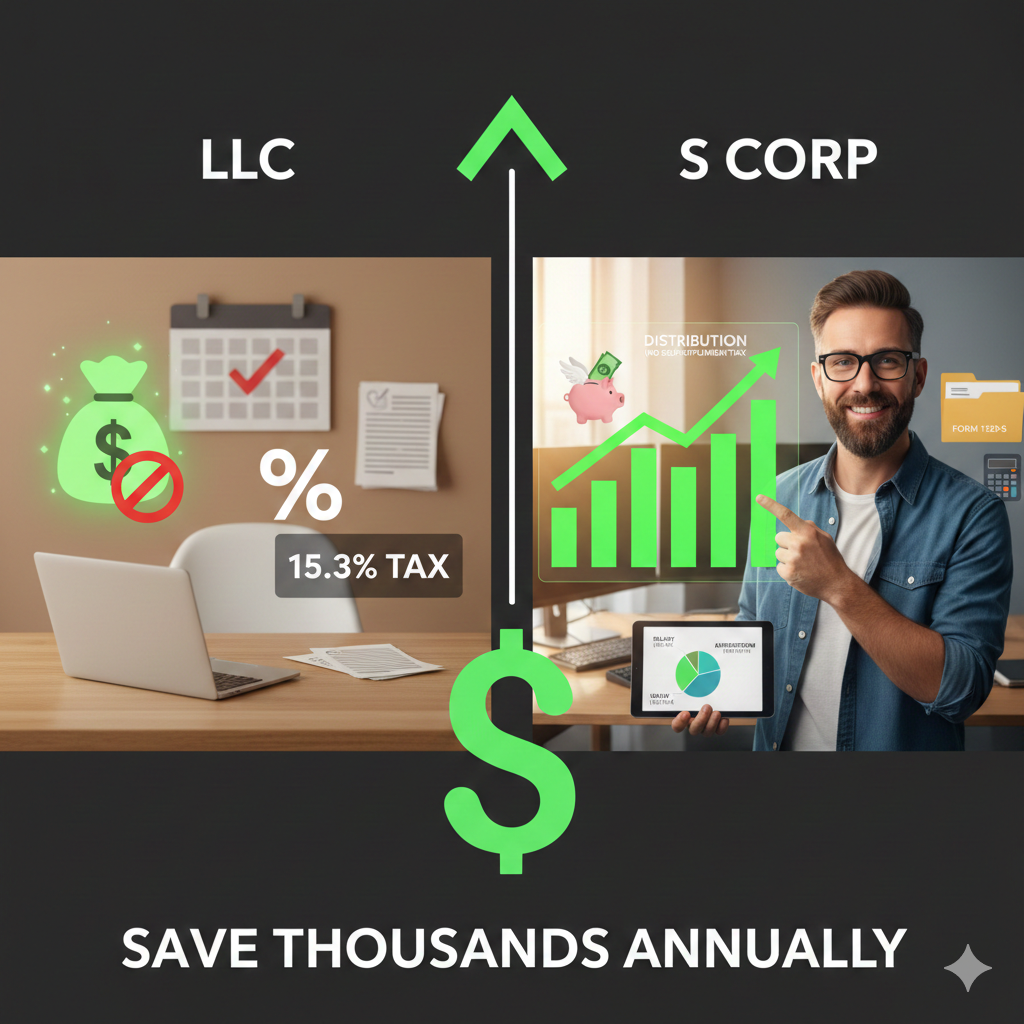
1. The Legal vs. The Tax: What’s the Difference?
Before we dive into the math, let’s clear up a common misconception: An S Corp is not a type of business; it is a tax election.
- LLC (Limited Liability Company): This is a legal entity. It creates a “shield” between your business assets and your personal assets (like your house or car). By default, the IRS taxes a single-member LLC as a Sole Proprietorship.
- S Corp (Subchapter S): This is a status you “elect” with the IRS. You can have an LLC and ask the IRS to tax it as an S Corp. This changes how the money you earn is treated for tax purposes.
2. The “Hidden” Cost of Freelancing: Self-Employment Tax
When you work a 9-to-5, your employer pays half of your Social Security and Medicare taxes (7.65%), and you pay the other half (7.65%).
As a freelancer, you are both the employer and the employee. This means you pay the full 15.3% Self-Employment Tax on every dollar of profit you make. This is in addition to your standard income tax. This is where an S Corp election becomes a powerful tool.
3. How the S Corp “Tax Hack” Works
In a standard LLC, you pay 15.3% on 100% of your profit.
In an LLC taxed as an S Corp, you split your income into two “buckets”:
- Reasonable Salary: You pay yourself a W-2 wage via payroll. You pay the 15.3% tax only on this amount.
- Owner Distribution: The rest of your profit is paid to you as a distribution. This bucket is exempt from the 15.3% self-employment tax.
4. Real-World Examples: The Math Behind the Savings
Here is how the numbers look for three different freelance scenarios.
Note: S Corp costs assume ~$2,500 for payroll software, FUTA/SUTA taxes, and corporate tax preparation.
The “Junior” Creative (Net Profit: $65,000)
- LLC Tax (15.3%): ~$9,945
- S Corp Tax: You pay a $45,000 salary. Payroll tax is ~$6,885.
- The Result: You save $3,060 in taxes, but spend $2,500 on admin costs.
- Verdict: Stay an LLC. The $500 gain isn’t worth the extra paperwork.
The “Sweet Spot” Consultant (Net Profit: $100,000)
- LLC Tax (15.3%): $15,300
- S Corp Tax: You pay a $60,000 salary. Payroll tax is $9,180.
- The Result: After $2,500 in admin costs, you still have $3,620 extra in your pocket.
- Verdict: Time to Elect S Corp. ### The High-Earner Developer (Net Profit: $150,000)
- LLC Tax (15.3%): $22,950
- S Corp Tax: You pay a $90,000 salary. Payroll tax is $13,770.
- The Result: Even with $3,000 in higher admin costs, you save over $6,000 per year.
- Verdict: S Corp is a must.
5. LLC vs. S Corp Comparison Table
| Feature | Single-Member LLC | LLC with S Corp Election |
| Legal Protection | Full Protection | Full Protection |
| Tax Rate | 15.3% on all profit | 15.3% on salary only |
| Payroll Required? | No | Yes |
| Annual Paperwork | Low | High (Business Tax Return) |
| Audit Risk | Standard | Higher (if salary is too low) |
| Best For | Under $60k profit | Over $80k profit |
6. What is a “Reasonable Salary”?
The IRS requires S Corp owners to pay themselves “reasonable compensation.” You cannot pay yourself $1 just to avoid taxes.
To determine a reasonable salary, look at:
- Market Data: What would it cost to hire someone to do your job? (Check sites like Glassdoor or Payscale).
- Experience: A senior developer’s reasonable salary is higher than a junior’s.
- The 60/40 Rule: A common (but unofficial) guideline is to pay 60% of your profit as salary and 40% as distribution.
7. When Should You Make the Switch?
The “Sweet Spot” for most freelancers is $80,000 in annual net profit. If you are earning less than $60,000, the complexity of running payroll and filing a separate business tax return (Form 1120-S) usually isn’t worth it. However, if you are consistently hitting $80k or more, the S Corp is the most effective way to lower your tax bill.
Final Takeaway
Start as an LLC. It’s easy, cheap, and protects your assets. As soon as you see your profits climbing toward that $80,000 mark, talk to a tax professional about electing S Corp status. It’s the single biggest “level up” a freelancer can make for their finances.
HOW SURE FINANCIAL AND TAX SERVICE LLC HELPS?
For assistance in navigating your taxation and foreign financial need and ensuring compliance, consult SURE FINANCIAL AND TAX SERVICES LLC( dba SURYA PADHI, EA). SURE FINANCIAL AND TAX SERVICES LLC have the expertise to guide individuals and businesses through the complexities of tax forms, ensuring accurate completion and adherence to IRS requirements. By partnering with us, individuals and businesses can confidently manage their tax responsibilities while safeguarding sensitive information, thereby ensuring smooth operations and compliance with IRS regulations.Schedule a free 15 minutes meeting with us.
Our Contact : +1 908.955.0696 | contact@suryapadhiea.com | services@surefintaxsvs.com | https://suryapadhiea.com/
Follow Us : YouTube | Facebook | Linked In
SEO Keywords: LLC vs S Corp for freelancers, freelance tax savings, S Corp reasonable salary, self-employment tax, business structure for designers, Collective tax savings.
